
CCJC Audio Podcast Episode 000124, Season 2
Recently some of the Cajun Chronicles Podcast Corporation writer staff enjoyed a well attended writers conference at a ritzy island resort about as far away from Louisiana as you can get. Some of us were aware of the show Mother Nature was putting on there. Not only in terms of their native flowers and fruits, but also the job certain natural Apex Micro-Predators play around the world in the grand scheme of pest control and climate change globally.
Once home, those lessons and lessons about writing creative technical content were sources of wonderment and inspiration. Louisiana is no stranger to all things buggy, nor the climate change side-effects we have always been experiencing with rising waters all around us. Similarly, those among us struggle with solutions to writing and broadcasting the messages we all need to heed on such important topics.
A Fishing Spider Story Exercise In Creative Nonfiction Oddity
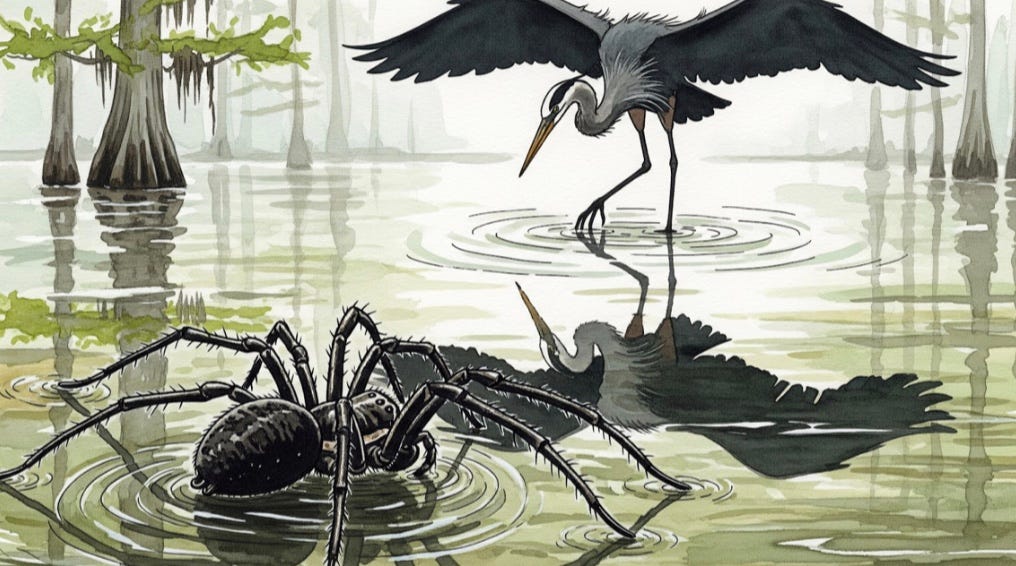
The thing about the Louisiana bayou country is that its weirdness is not just for show, cher. It’s a matter of absolute, high-stakes survival. It is an ecosystem that has perfected the art of the improbable. Take the Dark Fishing Spider, Dolomedes tenebrosus, the one whose leg span can cover half your hand. She is one of the largest spiders in North America, yet she operates with the silent precision of a naval scout.
You’re floating placidly in the moss-draped gloom of the Atchafalaya Basin, and there she is, perched carrément (directly) on a gnarled bald cypress knee. Her nickname is Scuba Spider. Unlike her cousin, the Six-spotted Fishing Spider (D. triton), who is a permanent waterside resident, D. tenebrosus often wanders about. She’s basically a French Quarter phantasm land tourist with aquatic superpowers. Uniquely, her front four long legs still rest on the water like silent radar antennae.
Here’s the first oddity: She doesn’t spin a trap-web to catch supper. She uses the very surface of the water as a vast, vibrating, liquid snare. That surface tension, which allows a single droplet of dew to hold its perfect sphere, is her hunting ground. To your amazement, a Yellow Fever (Aedes aegypti) mosquito lands, an unlucky Cocahoe Minnow (Fundulus grandis) minnow surfaces, or you see a mayfly struggling.
Those water disturbances, even a tiny ripple, are all the information she needs. She bolts across the water, comme ça (like that), defying gravity and the laws of physics with a waxy-haired gait, grabs her prey, and retreats just as swiftly. She is an apex-predator extraordinaire! As an Eight-Legged Lagniappe
The truly bizarre part of her story happens when danger comes. If a hungry Great Heron swoops too close, or a massive Alligator Gar glides by, this spider doesn’t run toward the shore. She, as we say in Cajun French, simply plonges (plunges/dives). Happily, for her, she’s not drowning. She’s engaging in a peculiar act of biological brilliance.
Her entire body is covered in fine, dense hairs. As she slips beneath the surface, these hairs trap a thin, glistening layer of air, her personal silvery scuba suit, that surrounds her like a portable bubble. She becomes a living submarine. She can cling to an underwater root, or the submerged bark of a Bald Cypress tree.
There she sits, breathing her little pocket of swamp-air, and waiting out the trouble for up to half an hour. She makes the L’Affaire Fini threat simply disappear. That fact, c’est vrai (that’s true), is a mighty fine trick.
Now, here is where the bayou’s natural spider oddity connects to a deeper, more human reality. She shows how to tell scientific facts about climate change and its effect on nature factually without putting your audience to sleep. That’s because the constantly-evolving existential crisis of the climate often feels a lot like that of the ol’ White Heron. It’s a huge bad case of the vois-là, an inevitable danger that you can’t run away from.
The way some creative technical writers are trying to capture that reality is just as strange as a certain spider species’ scuba dive. When you can’t outrun the misère (misery/trouble), you have to find a new way to tell the story.
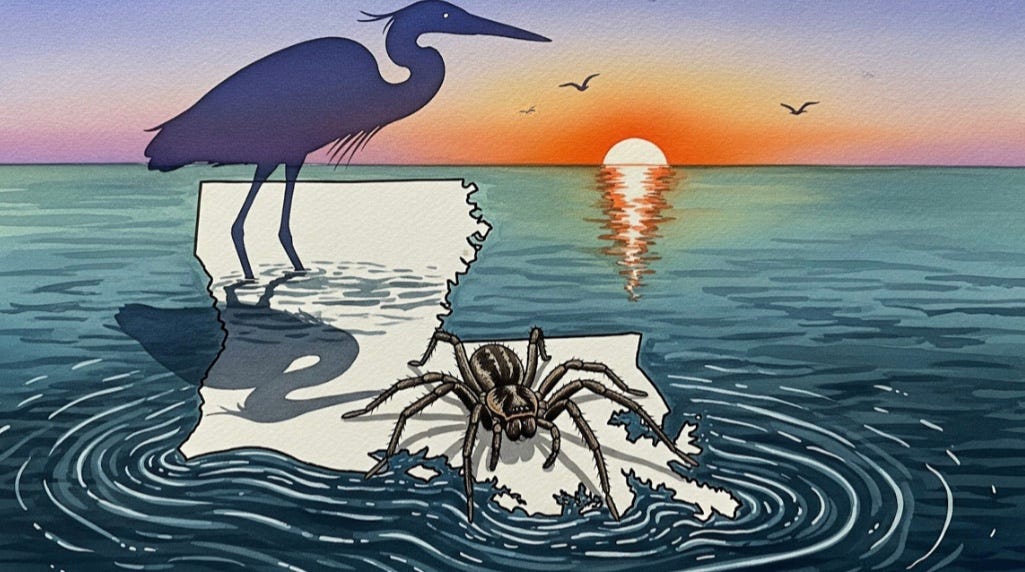
This is so much like very act of writing creative nonfiction through the climate crisis has its own set of odd, profound, and fun facts:
Odd Fun Facts of Writing the Existential Reality
1. The “Slow Violence” Problem Demands New Forms
The climate crisis rarely involves a neat, dramatic explosion. It’s mostly “slow violence.” The gradual, almost invisible rising of the water, the creeping salinity, the erosion of the marsh. The odd challenge for the Louisiana writer, is that they have to invent entirely new, often experimental, narrative techniques just to make a slow-motion disaster feel as urgent as a gunshot.
This is why you sometimes see writers like us using techniques like fractured chronology, list-memoirs, or braided essays. They are desperate attempts to make the un-dramatic and continuous nature of environmental trauma feel viscéral (visceral) to the reader.
2. The Rise of the “Carrier Bag Narrative”
Forget the epic traditional story of the single hero conquering the storm. Many climate writers are advocating for author Ursula K. Le Guin’s concept of the “Carrier Bag Theory of Fiction.” The odd fun fact here is that the best climate stories shouldn’t have a single, satisfying plot arc (a triumph!). They should be a messy “bag” full of diverse voices, ongoing processes, small acts of loss, and fragments of hope.
Strive for mirroring the complex, non-linear reality of the crisis. This form rejects the idea that a single person can ‘solve’ the problem, instead emphasizing the power of collective, ongoing endurance.
3. The “Chronology Crisis” Demands Time-Travel Memoir
In le poids de la terre (weight of the earth) aka existential reality, the past, present, and predicted future of climate trauma all exist simultaneously. A New Orleans resident is living in the present, but their memories of Katrina (past), and their fear of the next Category 5 hurricane (future) are a single, continuous anxiety, deeply felt tracas (worry/trouble).
The odd fun fact is that some creative nonfiction writers respond by using future-gazing memoir, telling the story of today through the lens of a fictionalized tomorrow. That’s a slippery quick sand road to make the reader feel the possible consequences before they arrive, turning the memoirist into a reluctant, mournful prophet.
4. Giving Voice to the “More-Than-Human” Wood
To truly capture our “constantly-evolving existential reality,” creative nonfiction has to be less about us. A strange but growing trend is to intentionally de-center the human narrator and adopt a practice like eco-biography. Trying to write the life story of the swamp, the salt dome, or the bald cypress. It’s the writer’s attempt to give the “more-than-human” world its own voice, ensuring the story isn’t just about human loss, but about the entire ecosystem’s struggle.
This often involves deep research into a non-human entity and presenting it with a level of detail and emotional weight traditionally reserved for human characters. This feels doux (sweet/tender), but it is actually fierce.
5. The Emo-Data Ratio (The “Empathy Coefficient”)
Climate change is not a problem of data ignorance. It is a problem of emotional numbness. The odd job of the creative nonfiction writer is to be the ultimate translator. Figuring out how to take a gigantic, cold number like “1.2 trillion tons of ice lost per year” and merge it perfectly with a visceral, personal emotion (the story).
This balance is the “Empathy Coefficient” of climate writing. Too much data, and the reader closes the book. Too much emotion, and the reader dismisses it as verbal fistfight. The fun, difficult fact is that the most impactful essays are the ones that hit this ratio precisely, making the scientific rigor feel personal.
6. The Glossary of Grief (Decolonizing Language)
Official, sanitized language often uses terms like “coastal erosion” or “managed retreat.” Watering vocabulary down while being respectful of a global audience whose English, may not be their first language, or playing to a specific reading level, also seems wrong.
The odd fun fact is that the most powerful creative nonfiction often requires inventing new words, or adopting local and Indigenous terms, to replace this bureaucratic detachment. It also entails understanding the rapidly changing generational nuances between generations of readers.
For a writer capturing the voice of a Cajun community, “coastal erosion” is replaced by a term that refers to “la terre qui pleure“ (”the land that cries”) or “le gras de la terre“ (the fat of the land that is melting away). This linguistic choice isn’t just stylistic. It’s an act of decolonizing the narrative, demanding that the reader feel the cultural and historical grief that the official terminology attempts to mask.
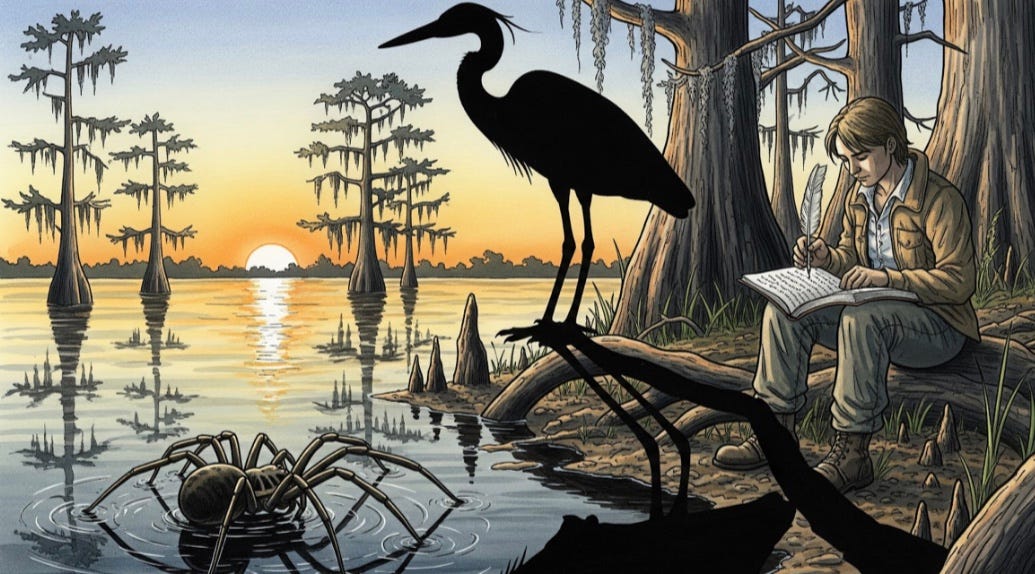
We’d like to think, as the Dark Fishing Spider sits in her silvery bubble beneath the water, the creative nonfiction writer is also performing their own survival trick. Turning the slow-motion, global storm into something small enough, strange enough, and compelling enough for more humans to finally grasp. If we tell the stories good enough to make a topic interesting to most readers, we have to avoid being too boring, too wordy, or too technical.
Yes, most of us can and have written very technical reports, but will forever prefer not to sink our audiences or drown them by forgetting to help them make the connection from the mind to the heart. Our call to action for all of us to survive a climate crisis issue too big to be seen whole, is to in many cases merge what we write with the one thing a pure scientific reports cannot offer. Just more ways to inspire others to feel, and therefore, find ways to act for the common good of all of us.
Nos amis (our friends), let this story of the little Scuba Spider be our collective call to the water’s edge. Much like Le Plongeur Dévot refuses to simply drown in Le Grand Glou-Glou of the tide, we, the storytellers and listeners of the bayou, must refuse to let the misère of our climate reality be dismissed as a dry file or a forgotten fact.
Now is the time to embrace la vraie affaire de l’Eau et la Terre. To find the right rhythm, the perfect empathy coefficient, and claim that powerful lagniappe of truth that moves the soul. Let the ingenuity of nature inspire the fierce creativity in your own heart, and use that urgency not to panic, but to act now, before our beautiful, wild world is gone. Allons, let’s bring that change!
A Word of Wisdom:
Our fictional and non-fictional tales are inspired by real Louisiana and New Orleans history, but some details may have been spiced up for a good story. While we’ve respected the truth, a bit of creative license could have been used. Please note that all characters may be based on real people, but their identities in some cases have been Avatar masked for privacy. Others are fictional characters with connections to Louisiana.
As you read, remember history and real life is a complex mix of joy, sorrow, triumph, and tragedy. While we may have (or not) added a bit of fiction, the core message remains, the human spirit’s power to endure, adapt, and overcome. Cajun Chronicles Audio Podcast - Bringing you the heart of Louisiana. All artwork generated with Google Docs Image Maker unless otherwise noted.
© Jerilee Wei 2025 All Rights Reserved.