
Decatur Street Immigrant Ledgers | G & M Family Secrets - Part 4
Unlocking the ‘G’ and ‘M’ Pages, Fruit Stands, Stolen Lemons & Unbroken Bloodlines of Decatur Street

CCJC: Episode 0000326, Season 3 - Segment Italian Immigrants
[SOUND EFFECT: VINTAGE RADIO STATIC TUNING IN, SLOW FADE TO THE RICH HUM OF A STUDIO CONDENSER MIC, THE CLINK OF ICE IN A GLASS OF SWEET TEA, AND THE CRISP FLIP OF HEAVY HEIRLOOM PARCHMENT]
DOMINIQUE: Welcome back to the Cajun Chronicles Podcast studio, everyone. If you were listening last night, you know we left you dangling right on the precipice of page eighty-eight.
LAURENT: That’s right. Last episode, Signora Elena completely blew the doors off the “Ghost Voter” racket of the 1904 4th Ward elections.
Those were the names that vanished off Decatur Street faster than a mudbug trying to escape capture at a Sunday Cajun boil.
DOMINIQUE: But tonight, we are keeping our promise. Sitting across from us, wearing her signature gold bangles and clutching the 1907 Ledger of Sicilian Family Surnames.
For her the ledger is like the Rosetta Stone of the French Quarter. Joining us again, is the one and only Signora Elena. Elena, we are finally diving into the ‘G’ and ‘M’ sections!
ELENA: (Chuckling, a warm, resonant laugh) Darlings, sharpen your pencils and pull up your very fine Herman Miller Aeron Chairs!
Because if you thought the ‘A’ and ‘S’ pages were wild, the ‘G’s and ‘M’s are where the real blood, sweat, and citrus of New Orleans Italian immigrant history live.
LAURENT: Before you crack that spine, Elena, give us a little context. Why were the ‘G’ and ‘M’ ledgers so massive in 1907?
ELENA: Because, Laurent, in 1907, Decatur Street was powered by two things. Sicilian immigrants and Mediterranean produce!
The letters ‘G’ and ‘M’ represented the heavy hitters, the Giacones, the Gaglianos, the Marcheses, the Mancusos.
These were the families who didn’t just work the French Market; they literally built the wholesale produce infrastructure of the Deep South from wooden crates on the riverfront!
DOMINIQUE: Alright, let’s get right into it. What is the first unaltered entry staring at you on page ninety-two under ‘G’?
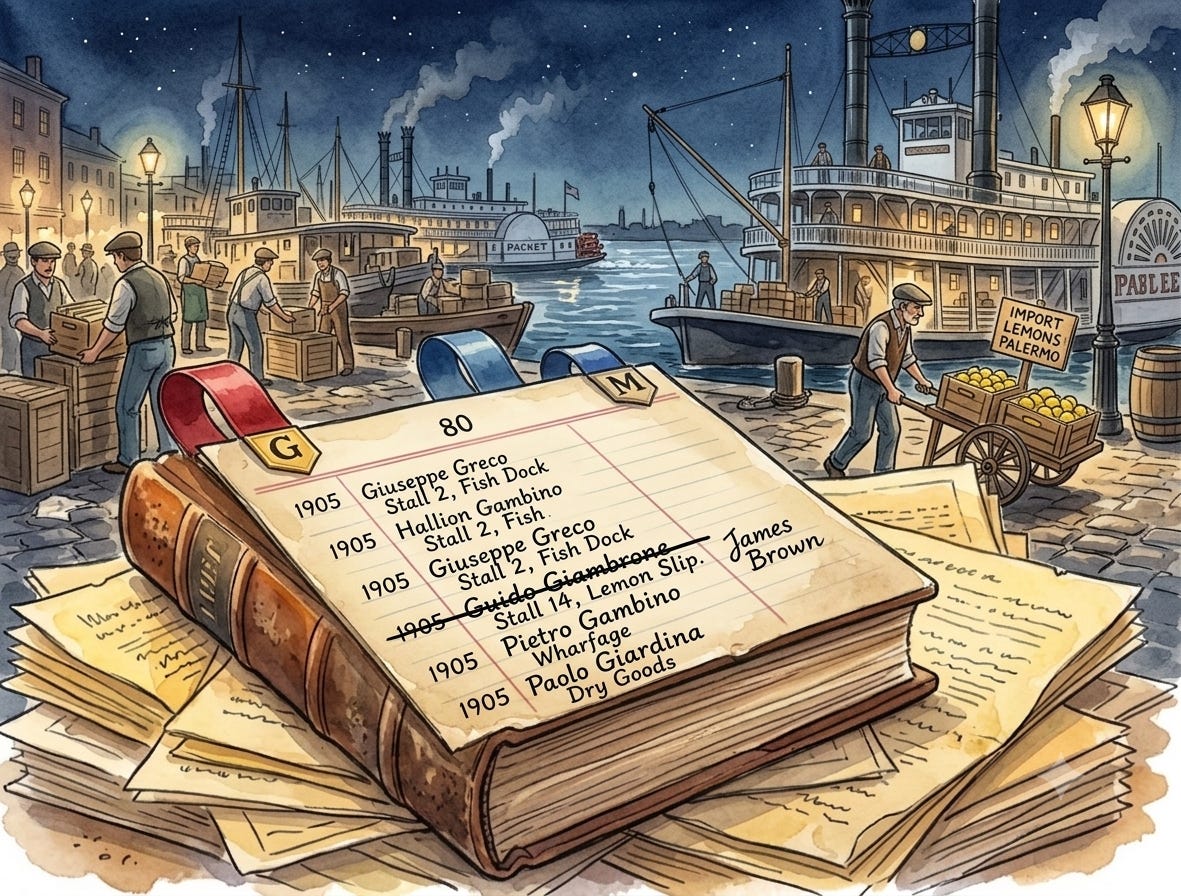
ELENA: (Tracing a faded line of ink with her finger) Ah! Look right here: Giambrone. Originally from Caccamo, Sicily. Now, the official port records in 1905 listed the father as “James Brown.”
LAURENT: (Laughing) James Brown? From Caccamo?
ELENA: (Laughing) Can you imagine? The clerk took Giambrone, a classic Sicilian name and turned a proud citrus vendor into the “Hardest Working Man in Show Business!”
LAURENT: (Snickering) Right, instead of carrying crates of lemons on Decatur Street, the dock clerk had him down as if he were about to drop to his knees, throw a cape over his shoulders, and launch into “Papa’s Got a Brand New Bag” fifty years early!
DOMINIQUE: Imagine a 1905 port inspector listening to a Sicilian merchant yell out his prices in the French Market, only to log it under 1960’s R&B.
He looks at his clipboard and writes down “I Got You (I Feel Good),” except the only thing feeling good was the guy who just sold a crate of Palermo oranges for three dollars!
ELENA: All joking aside, what really happened is that the clerk took Giambrone, a real surname, that was manipulated and . . . . well, with just a slight of the pen, changed his legacy.
Look at the handwritten margin in our 1907 ledger. Lu Patruni didn’t call him James Brown. He wrote: “Guido Giambrone Stall 14, Lemon Slip.”
Guido ran a single wooden handcart selling imported Palermo lemons right where the Mississippi River packets boats tied up near Ursulines Street.
DOMINIQUE: Now, I seem to remember my elders saying that there was an odd little feud on Decatur Street involving lemons back then?
ELENA: Oh, honey, the Great Lemon War of 1906! People think true crime started with bank robbers, but back then, lemon cargo was absolute gold because of scurvy prevention and flavor for local oysters.
The Giambrones and the Gaglianos had stalls right next to each other. One night, twenty barrels of Sicilian lemons vanished off the dock.
The police assumed it was street thieves, but local lore says the entire batch was hidden under a pile of cone head Cajun Charleston Wakefield cabbage at a parish farm in Lafourche until the heat died down!
LAURENT: (Shaking his head) Makes me think of my Grand’tante Marie’s Choux Étouffé (Smothered Cabbage). I can picture her hiding some). Hidden in cabbage! That leads us right into the ‘M’ section. What do we have under ‘M’, Elena?
ELENA: (Flipping the heavy page with a satisfying thump) Page one hundred and twelve. Look at this magnificent family name: Marchese.
DOMINIQUE: Now, Marchese translates to “Marquis” or “Nobility,” right?
ELENA: Yes, Dominique! In Italy, it denoted noble heritage. But when young Pasquale Marchese arrived at the Decatur Street docks, he wasn’t wearing velvet coats.
He was hauling fifty-pound sacks of garlic! The local riverfront inspectors couldn’t pronounce Marchese properly, so on his vendor tag, they wrote “Markess.”
LAURENT: From Marquis to Markess with one lazy stroke of an ink pen.
ELENA: But here is the magic of the ‘M’ families, Laurent. Pasquale didn’t let that misspelled tag stop him.
He took that tiny fruit stand, kept his real name spoken proudly in Sicilian behind the counter, and by 1915, his family owned three wholesale trucks servicing the entire 4th Ward!
DOMINIQUE: It just goes to show you, Lu Patruni could try to shuffle those ledgers. and city clerks could butcher the spelling. But the sheer grit of those families held the riverfront together.
ELENA: (Closing the ledger gently, resting both hands on the leather cover) That’s why we read and need to preserve these ledgers today, darlings. Not to mourn the erased ink, but to speak the real names out loud again.
LAURENT: Signora Elena, you’ve done it again. Listeners, that brings us to the end of tonight’s look into the ‘G’ and ‘M’ archives, but the history of our coast is far from over.
DOMINIQUE: Until our next episode, keep looking past the typos in your census records, honor the hard work in your bloodlines, and remember. Your ancestors wrote the story, you’re just keeping their truths alive.
LAURENT: We aren’t done with this ledger yet, or the Sicilian Italian Immigrant stories that made Louisiana culturally what it is today. Elena will be back with us in a few days, to share about the shadows behind the counter: Midnight Blades, Struck-Out Ink, and the 1907 Grocer Attacks
Bonsoi Good night dear listeners! Bonsoir, New Orleans! Hold onto your palmetto straw hats, don’t let the mosquitoes bite, and laisse le bon temps rouler till sunrise
[SOUND EFFECT: LAID-BACK BAYOU JAZZ FIDDLE DRIFTING OUT OVER DISTANT STEAMBOAT WHISTLES, SLOWLY FADING TO SILENCE]
Has your surname ever been altered, shortened, or transformed across generations? Or did Did your family history vanish behind a dock clerk’s pen or a parish alias?Drop your family name and story in the comments below, Signora Elena might just look it up in our next episode!
“A Padrone could take away a man’s vendor license, and a clerk could misspell his birthright, but the grit and determination behind the ledger entries belonged to the family alone.” – Signora Elena
A Word of Wisdom:
Our fictional and non-fictional tales are inspired by real Louisiana and New Orleans history, but some details may have been spiced up for a good story. While we’ve respected the truth, a bit of creative license could have been used.
Please note that all characters may be based on real people, but their identities in some cases have been Avatar masked for privacy. Others are fictional characters with connections to Louisiana.
As you read, remember history and real life is a complex mix of joy, sorrow, triumph, and tragedy. While we may have (or not) added a bit of fiction, the core message remains, the human spirit’s power to endure, adapt, and overcome.
Cajun Chronicles Audio Podcast - Bringing you the heart of Louisiana. All artwork, images, and videos are generated with Google Docs Image Maker and Gemini Pro unless otherwise noted.
© Jerilee Wei 2026 All Rights Reserved.
Caught in the Middle of the Story?
If you’re just joining us on the docks, you can catch up on the earlier chapters of this series anytime. We’ve already explored the early arrival of Sicilian Italian families along the French Market, the initial 1890’s tensions in the 4th Ward, and how local ledgers first began tracing these changing identities.
Listen or read to Parts 1–3 Here:
Part 1 - Rescuing the Silent Sicilian Italian History of the French Market
Part 2 - What’s in a Name? The Mystery, Manipulation, and Magic of Sicilian Surnames
Part 3 - What’s in a Name? The Mystery, Manipulation, & Magic of Sicilian Surnames