
Chasing Catfish, Hooking History: A Ghost in the Atchafalaya
Hooking Louisiana's Rarest Dinosaur: The Endangered Pallid Sturgeon

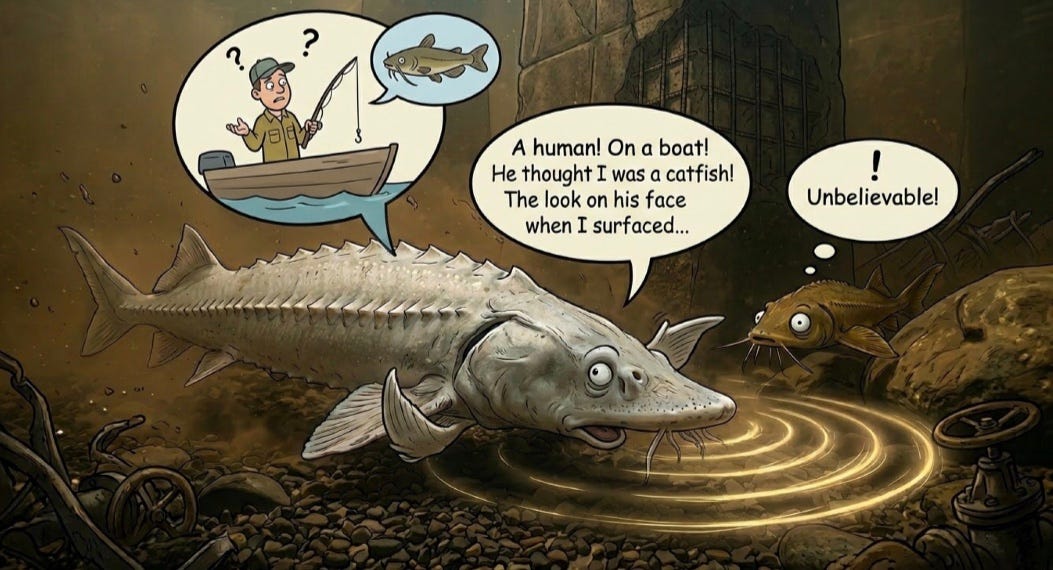
Here at the Cajun Chronicles Podcast Corporation, if you hang around the docks long enough, you’re gonna hear a lot of fishing stories. Mostly, they’re about ‘the big one that got away,’ usually told by some guy holding his hands three feet apart, swearing on his mama’s secret roux recipe that it was a trophy Channel Blue Cat.
But have you ever stopped to wonder about the story from the other side of the boat’s gunwale? Have you ever heard it from the literal perspective of the one who got away?
Today, we’re doing something a little different. We’re throwing on our highest-tech cooling shirts and diving sixty feet straight down into the pitch-black, silt-heavy mud at the absolute bottom of the Old River Control Structure in Concordia Parish.
Listen and read what our Co-host, Laurent Thibodaux found out, as he traced a story sent in by one of our listeners. This inspired our guest interview today, who isn’t a local guide or a tournament pro.
Now Laurent likes to go straight to the original source. This time he was speaking with an eighty-pound, blind, seventy-million-year-old living dinosaur with a cartilage skeleton and a vacuum cleaner for a mouth.
Getting a first-hand perspective on what it feels like to be hooked by a clueless tourist from New York, straight from a Pallid Sturgeon who survived to thrum the tale.
Because as it turns out, both this ancient fish and the massive, concrete federal fortress it calls home have some high-stakes, history-altering fishing stories that every single person living in, or just visiting, Louisiana absolutely needs to know.
Grab your Bam-Bam” Spicy Muffuletta from Verti Marte (located right on Royal Street), and perhaps that chilled can of Louie Louie Satsuma Hemp Seltzer you brought from home. Adjust your drag, and listen close. Because the river is about to speak back.
Oshá:
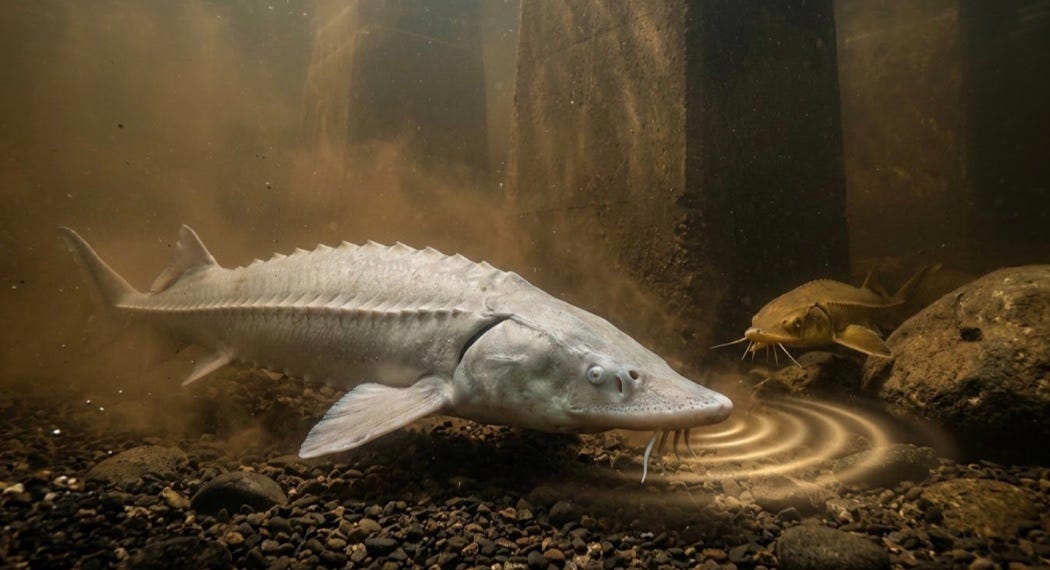
Down here, sixty feet below the surface, the sun is a myth. I don’t need the sun. My eyes are small, cloudy marbles that haven’t seen a clear image since I was a fingerling over forty years ago. Instead, I glide over the gravel on five rows of razor-sharp armor plates.
They are my scutes. I have no bones. Just a flexible, ancient frame of cartilage, heavy and low, built to hug the mud while the engineered, hyper-fast current of river water rages above me.
“You’re hunting too close to the concrete, Oshá,” a voice vibrated through the water.
It was a Shovelnose Sturgeon whom I know as Sifflet. He’s a younger, much smaller cousin, barely five pounds to my forty. He was a deep, yellowish-brown, resting his belly against the rocks.
Unlike mine, his smooth belly was armored with tiny plates. He looked like a toy version of me, but his whiskers. His “little beard” barbel whiskers were all the same length. On my snout, the two inner whiskers were short, barely half the length of the outer ones.
“The water moves where it moves, kid,” I thought back, sending a low thrum through the silt. “The Core of Engineer humans changed the river paths decades ago. If we don’t hunt the eddies by the gates, we starve.”
“Watch yourself,” Sifflet warned, his barbels twitching. “The local folks up top on the bayou call us le sifflet. the whistle fish. They tell their childrenThe Dying Breath bedtime story.
The story goes that Le sifflet was crying out or “whistling its own funeral dirge. Les Vieux (pronounced “lay vee-uh), Old timers believed that the whistle was the ancient fish cursing the person who dragged them from the mud.
Because of that, keeping a whistling fish on board would bring a sudden storm or ruin the rest of the day’s catch.
Somehow they still think we whistle when they haul us up. But people, the Houma and Chitimacha, used to call us Nani Kula or Nani Miko, the chief fish.
Back when we ruled the whole channel. They called your kind Oshá, the ancient pale one. Now we’re just ghosts hiding in the dark.”
Suddenly, my outer barbels twitched. They didn’t just feel the water; they tasted it, picking up a distinct chemical trail, accompanied by a faint, rhythmic electronic pulse. A dying minnow? No. It was too heavy. It tasted like grocery-store shrimp, starting to turn sour.
I hovered over it. My blind eyes saw nothing, but my whiskers mapped the precise coordinates of the flesh. I dropped my head, and with a sudden hydraulic snap, my mouth protruded completely out of my skull.
A vacuum hose extending from a ghost. I sucked the meat in. An instant later, a cold, metallic spike bit into the soft cartilage of my jaw.
Thump.
The line went taut, pulling my head violently toward the sky.
“Line!” Sifflet vibrated, darting behind a boulder. “He’s got you, Oshá! Fight the pull, drop into the rocks!”
I didn’t panic. I have survived sixty years in this river. I survived the great floods, the toxic chemical spills of the industrial corridor, hurricanes, and the changing currents.
But being pulled upward was terrifying. I am a creature of the dark, dense bottom. The water became lighter, thinner, and painfully warm.
Above the surface, the world was a chaotic assault of blinding light and dry, choking air. I couldn’t breathe. I thrashed my massive, shark-like tail, my heavy armor slapping against the side of a shiny aluminum boat.
“Yo, Mike, get the net! Grab the net, bro! I got a monster! It’s a blue catfish, it’s gotta be forty pounds!”
The voice belonged to some New Yorker named Kevin. He was a quintessential newcomer, a guy from Queens who spent his life dodging traffic on the Grand Central Parkway until a project manager job at a chemical plant brought him down to Baton Rouge three months ago.
He bought a bhass boat to live out his swamp-fisherman fantasy. He was sporting brand-new gear. And was dressed in Huk streamlined, athletic, tournament-inspired aesthetic shorts and shirts for active sweat-activated cooling.
But Kevin possessed zero knowledge of me as a 70-million-year-old relic he had just dragged out of the abyss.
He hauled me over the upper edge of the boat’s gunwale. I thudded onto the hot metal deck, gasping, my pale, chalky-white skin turning a stressed pink in the humid air.
“What the hell is that?” Kevin whispered, his urban swagger evaporating into pure bewilderment. He stared at my flat, shovel snout, my tiny, useless eyes, and the terrifying rows of prehistoric spikes on my back.
“Is it an alligator? A shark? Look at its mouth, it’s like an alien!”
He reached out a gloved hand, touching my soft, scaleless belly. It was completely smooth. He fumbled with his smartphone, his thumbs flying as he typed into a search engine: name of weird armor fish Mississippi river Louisiana.
I laid there, my prehistoric heart beating a slow, heavy rhythm against the aluminum. I thought of my mother, who had spawned me in a wild Mississippi river sections that no longer exist.
I thought of the billions of larvae that drift down these rivers every spring, only to die in stagnant reservoirs because humans straightened the channels.
My species was down to a few thousand ancient survivors. Here I was suffocating on a boat because a guy from New York wanted a fish fry viral post on his Instagram.
“Mike, look at this,” Kevin said, his voice dropping into a tense, quiet serious tone. He was reading from his screen. “‘Pallid Sturgeon. Federally endangered since 1990.
Known historically in Cajun French as esturgeon blanc or le sifflet blanc.
Do not remove it from water!’ Hey, look here, the Native name is listed as Oshá. The inner whiskers are short. This is it. This is a Pallid.”
He looked around the empty, sun-baked river, suddenly terrified of a La Loi game warden appearing from the tree line. But it wasn’t just fear of a fine. I felt the shift in his movement. The aggressive triumph of a city fisherman vanished, replaced by a sudden, heavy reverence. He was looking at a dinosaur.
“Get the pliers. Fast,” Kevin ordered. “Don’t even dare take a picture. The website says it needs to go back right now. There’s a criminal fine under an ESA law that includes keeping the fish once it’s out of the water.
The fine can be criminal misdemeanor fines of up to $50,000 for that ugly fish. Plus a year in a federal prison. Plus, they can seize the boat, trailer, and truck and auction them off. And whatever you do, don’t tell anyone about this fish that got away,”
With trembling hands, he pinned my heavy body down, carefully avoiding my sharp scutes. He gripped the Gamakatsu Big Cat Circle Hook, twisting it neatly out of the cartilage of my vacuum-mouth.
He didn’t lift me. He leaned over the side of the boat, tipping the heavy plastic netting until I slid backward, tail first, into the brown, comforting embrace of the Atchafalaya.
The cool, muddy water hit my gills. I sank like a stone, the blinding light fading into beautiful, perfect darkness.
I hit the bottom gravel with a heavy thud, letting the current wash the lactic acid from my muscles. A few feet away, a pair of dark whiskers twitched in the mud.
“You’re alive, Oshá,” Sifflet vibrated, swimming out from the shadows of the control structure. “What did they do to you?”
I adjusted my armor, letting my long, uneven barbels taste the river floor, searching for the next meal in a world that wasn’t built for us anymore, but one we refused to leave.
“They figured out who I was,” I thrummed back. “Just barely.”
“C’est le bon,” my friends. Next time you’re sitting on a comfortable high-rise balcony looking out over the Mississippi River, or sitting on a boat deck swatting at a cloud of marsh mosquitoes, take a second to look down.
There is a whole ancient world sliding through the pitch-black mud beneath us that doesn’t care about our Instagram likes, our tournament-inspired shirts, or our fancy new gear.
They’ve outlived the real dinosaurs, they’ve outlived the great floods, and if we behave ourselves, they might just outlive our city fantasies, too.
So if you ever hook something that looks like an alien vacationing from the Cretaceous period, do yourself and your wallet, a massive favor.
Skip the selfie, drop him back into the dark, and remember that sometimes the best fishing story is the one where the ghost gets to keep its home.
I’m Laurent Thibodaux, and until next time, keep your line wet, your drag adjusted, and remember to listen closely because here in Louisiana, the bayou always has the final word.
A Word of Wisdom:
Our fictional and non-fictional tales are inspired by real Louisiana and New Orleans history, but some details may have been spiced up for a good story. While we’ve respected the truth, a bit of creative license could have been used.
Please note that all characters including Mother Nature’s creatures may be based on real beings, but their identities in some cases have been Avatar masked for privacy. Others are fictional characters with connections to Louisiana.
As you read, remember history and real life is a complex mix of joy, sorrow, triumph, and tragedy. While we may have (or not) added a bit of fiction, the core message remains, those of us on this planet’s spirits have power to power to endure, adapt, and overcome.
My eyes aren't what they used to be, but some spelling choices here are purely on purpose! To keep those computerized "bot" readers from getting confused and talking about strumming a bass guitar instead of catching a prize bass out of the water, I've spelled a few things phonetically. It keeps the story straight for all our listeners worldwide. No need to send the spelling posse after us, we're just looking out for the folks listening along!
Cajun Chronicles Audio Podcast - Bringing you the heart of Louisiana. All artwork generated with Google Docs Image Maker unless otherwise noted.
© Jerilee Wei 2026 All Rights Reserved.

Jerileewei’s Substack Cajun Chronicles Podcast Series is a reader-supported publication. If you’ve got a soft spot for the big river and the ancient fish that call it home, consider throwing a line our way by becoming a free or paid subscriber.
Great! I loved this!